

AI continues to advance in remarkable and unprecedented ways. But while generative AI’s progress may be unprecedented, what isn’t new is the threat of novel technologies reshaping work for millions of Americans. In the past, the front line defense for U.S. workers managing such transitions has consisted of two levers: labor unions that could give them a voice in how technologies were designed and deployed at their jobs, and a safety net that could support workers while they retrained and looked for new work. Yet both the labor movement and our safety net for out-of-work Americans have frayed considerably since mid-century. As a result, workers are confronting the threat of labor market disruption from AI at a historic low point for union membership and with an especially stingy safety net for the jobless.
Policymakers responding to the potential threats AI poses to the economy should thus consider ways of strengthening the labor movement and rebuilding our support for unemployed workers. An idea I’ve been developing—“Solidarity Insurance”—offers one way of achieving both goals at once. Solidarity Insurance would involve deputizing labor unions to run a revamped system of jobless benefits and retraining services, in the process creating opportunities for workers to connect with unions and organize collectively across the country.
The threat of tech displacing workers isn’t new
75 years ago, a leading labor federation sought to help its members understand the threats new technology posed to their jobs, including machines automating assembly lines. Their leadership argued that businesses “tell us that some of the newest gadgets are simply marvelous…and some of them closely resemble ‘mechanical brains.’ That isn’t any comfort, however, to the man who’s been tossed out of a job by a machine…he’ll probably say, ‘Yeah! But what am I supposed to use for money?’”
So the mounting anxiety about what AI might do to the American economy reflects a long history of technology threatening labor power.
Facing that earlier wave of technological disruption, the Congress of Industrial Organizations (CIO) stressed that it had “never been known as an organization that sought to halt technical developments.” What the CIO wanted instead was power: power to shape “the manner in which technological change is introduced,” to ensure that the gains from new technology would be shared with American workers, and, above all, to protect “the welfare of those who lose jobs through no fault of their own.”
The CIO’s approach—fighting for labor’s voice to shape the design and deployment of new technologies as well as for the welfare of displaced Americans—worked in its time, delivering a generation of broadly-shared growth that swelled the ranks of the middle class. It holds the same promise in our AI age.
Two big obstacles to shared prosperity in the AI economy
But two key obstacles stand in the way of delivering shared prosperity in an economy reshaped by AI. The ability of Americans to bargain collectively over the terms of their jobs is far weaker today than in the 1950s: union membership has fallen from roughly a third of the workforce to about one in ten workers. This means that technological change is now something that just happens to workers, rather than something workers have the power to shape. In addition, the safety net for displaced workers—fought for and built by organized labor—has eroded over the decades, offering ever-stingier support to out-of-work Americans. Perhaps most concerningly, the protections offered by unemployment insurance (UI) have weakened considerably since the mid-century, with a smaller and smaller proportion of unemployed Americans claiming benefits.
The good news is that policymakers can rebuild worker voice and strengthen the safety net at the same time; indeed, each can reinforce the other. I call this approach “Solidarity Insurance.”
We need Solidarity Insurance
Solidarity Insurance would reform our existing UI system to create new freestanding “worker choice” funds operated by labor unions or worker centers to pay benefits to unemployed workers, match workers with new jobs, and connect them with retraining opportunities. Participation in the program would require government certification as a bona fide labor organization. When a worker loses their job, they would have a choice to enroll in a state-run UI fund, or to enroll instead in a union-run fund, directing their payroll contributions there, and turning to that fund for benefits, job search help, or retraining if they lose their jobs.
These worker choice funds would be run by labor unions or similar worker organizations—such as worker centers and other worker advocacy groups—building on these groups’ extensive experience delivering these services and their deep connections with workers across the country. Worker choice funds would operate alongside traditional UI funds run by state governments, and would be financed through payroll contributions from employers and workers as well as federal subsidies. (Worker choice funds could charge additional contributions above and beyond the standard UI tax rates for additional services, too.)
Payroll contributions and payments would follow workers. If a worker opted to enroll in a union-run worker choice fund as opposed to a traditional state program, the state would transfer sufficient funds to cover benefit payments in that worker choice fund. In this way, Solidarity Insurance would layer onto the existing UI system, offering workers a different choice for managing their benefits and reemployment support. (As I discuss below, Solidarity Insurance should also be part of a broader set of reforms to bolster UI finances, access, and benefits).
Putting worker organizations in charge of supporting displaced workers (or workers at risk of displacement who want retraining) would ensure that labor market benefits and services actually respond to workers’ needs, and that displaced workers land in good-paying, high-quality, union-covered jobs. Just as important, it would seed new opportunities for labor organizing, growing the labor movement itself. Both American history and the experience of peer democracies with stronger labor movements point to the power of worker organizations connecting workers to the safety net—unemployment benefits, training programs, and job search assistance alike.
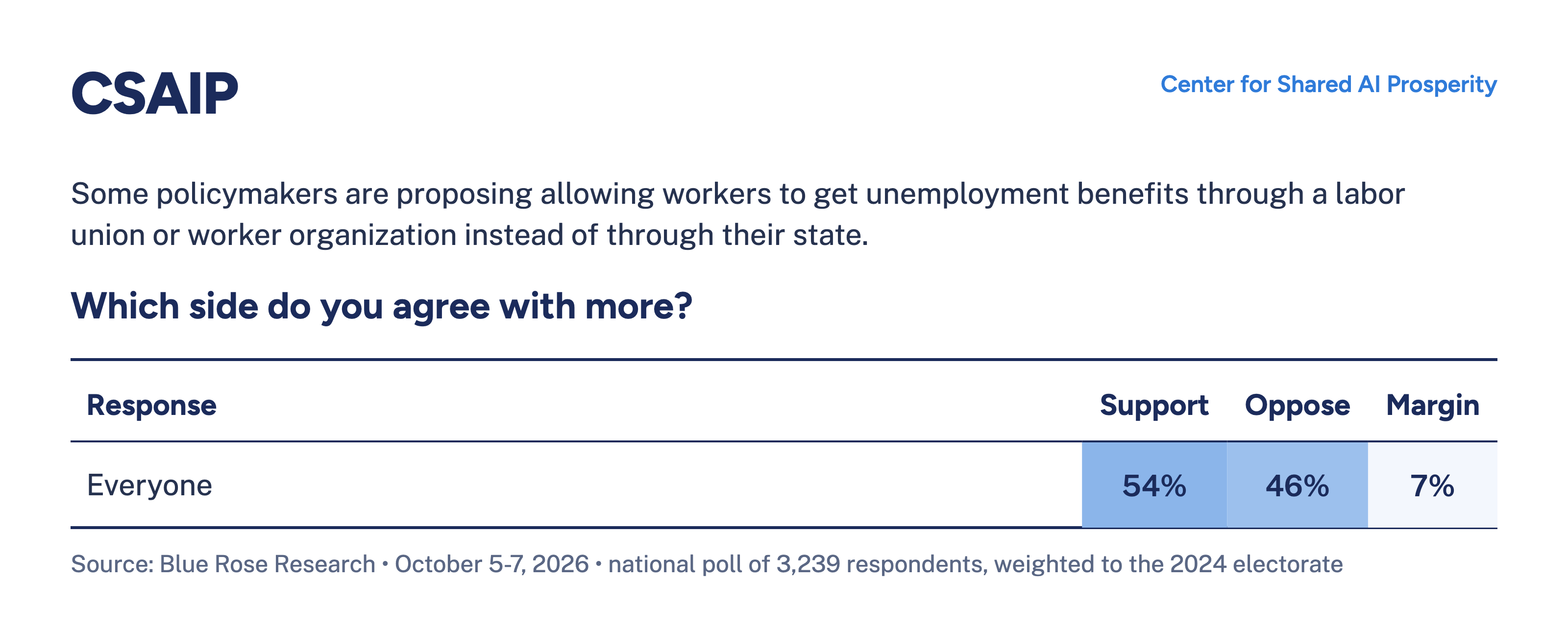
Americans support putting worker organizations at the center of the response to AI displacement. Polling conducted by the Center for Shared AI Prosperity (CSAIP) with Blue Rose Research found that at least half of all voters supported the idea of Solidarity Insurance after hearing about pros and cons of the policy.
How can policymakers move to Solidarity Insurance?
Ideally, Congress would pass new legislation explicitly creating a legal framework for union- or worker-organization-run funds to pay out benefits and provide training and job search assistance to workers.
Any legislation must also reform the UI system to safeguard workers in the AI era, by closing the current UI system’s gaps in eligibility (especially for the growing number of gig workers or independent contractors excluded from the UI system), generosity, and duration and setting benefits at levels adequate for American workers.
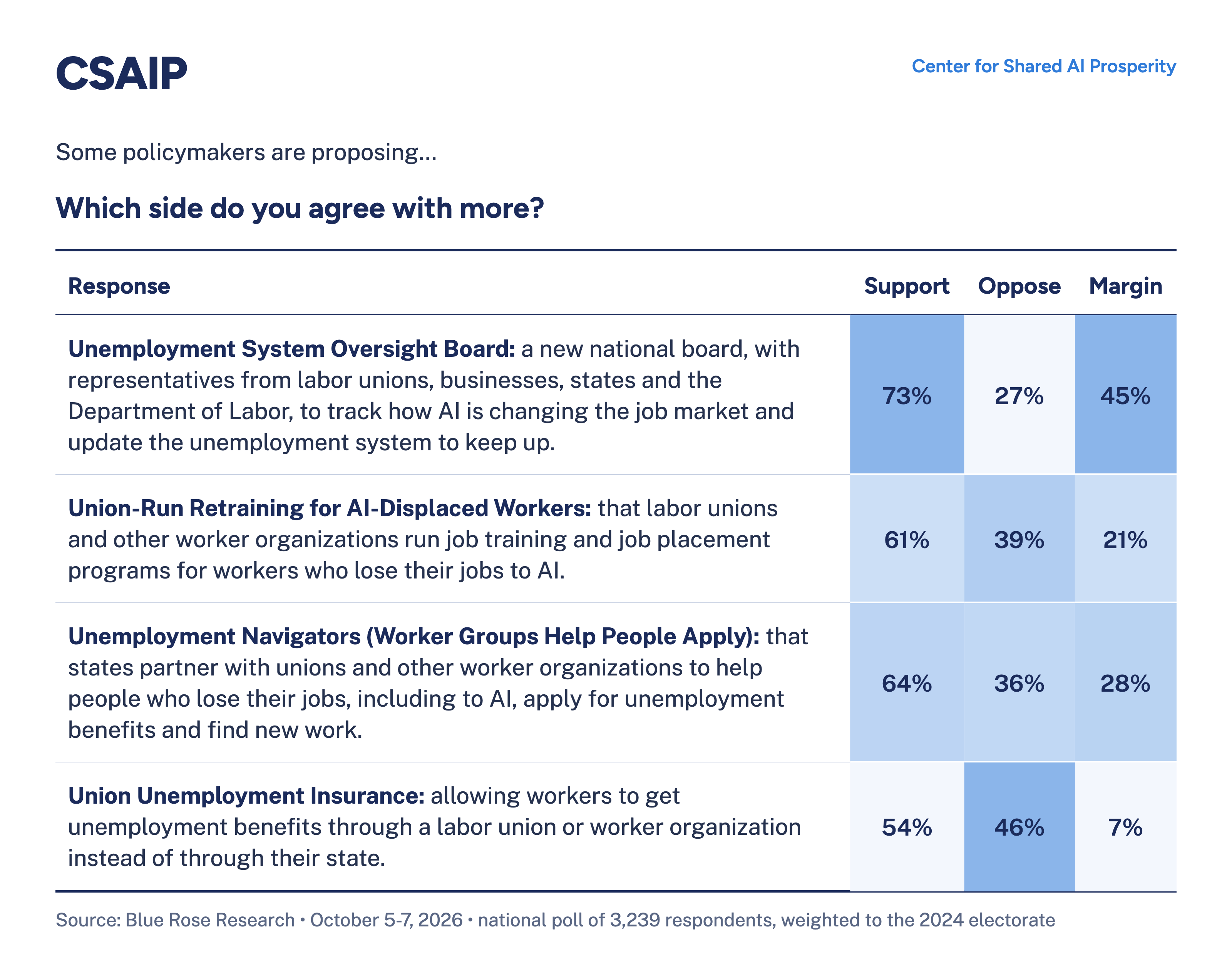
Solidarity Insurance also belongs in a bigger UI reform package that creates a greater role for labor in managing the transition to an AI economy. Polling by CSAIP and Blue Rose Research found that while Americans expressed moderate support for Solidarity Insurance, they were even more supportive of proposals that would create union-run training options for workers (at 61% support), union-run assistance for applying for UI benefits and finding new work (64% support), and building unions into a new governance structure together with businesses and states to ensure that UI is responsive to changes in the labor market (73% support). Voters were also very supportive of taxing AI companies to improve UI system funding (75% support). These are all changes that could be bundled with Solidarity Insurance.
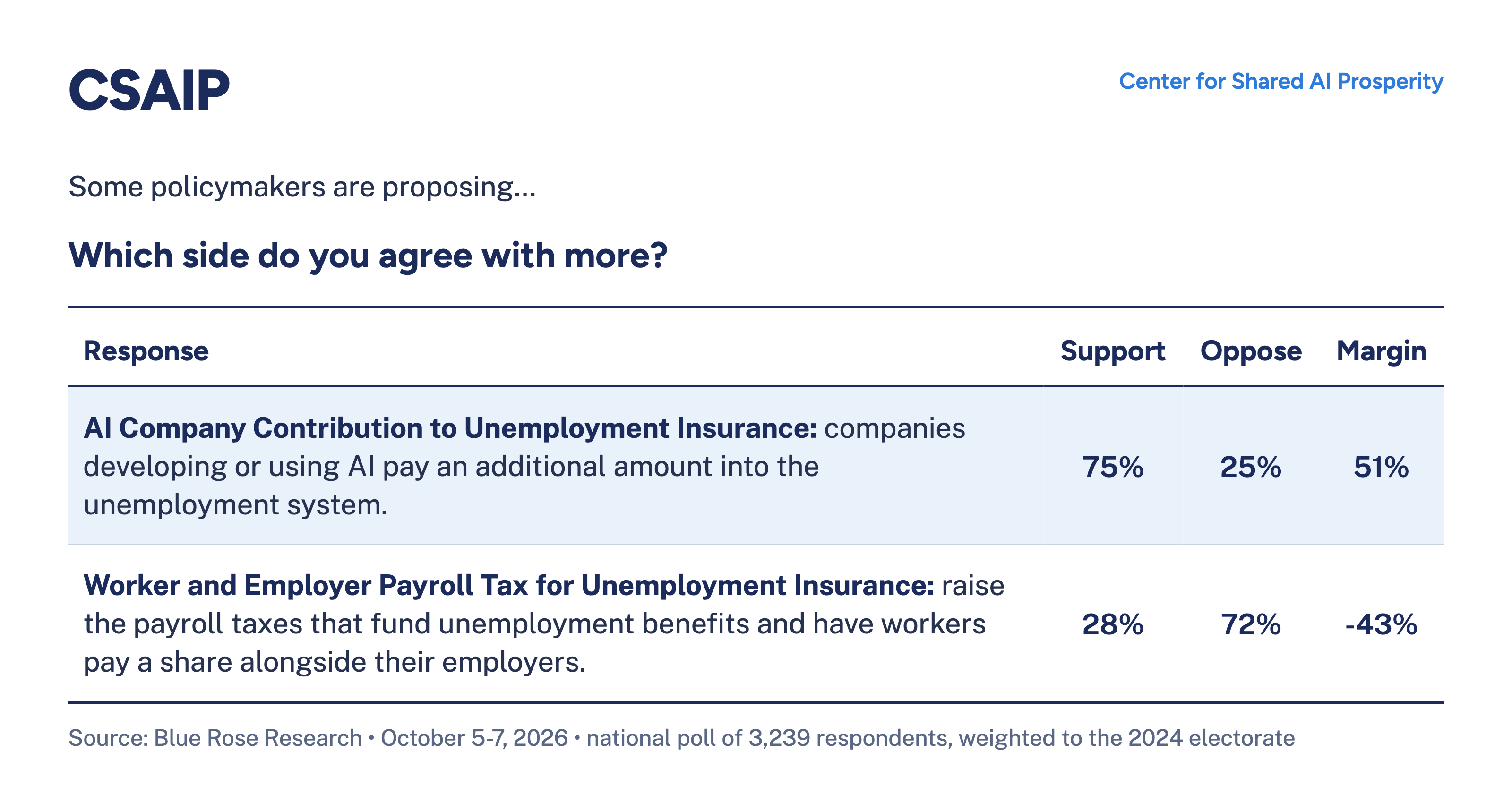
Part of that broader reform package should include bolstering UI finances. Policymakers should consider additional payroll taxes by employers and workers (which would maintain the sense of an earned benefit, key to the program’ political durability) alongside other revenue sources, including from companies that are developing or implementing AI tools at work. Polling from CSAIP finds that voters are very strongly supportive of AI company contributions to bolstering UI finances, much more so than worker or broader employer contributions. At the same time, policymakers should carefully weigh the trade-offs between the popularity of outside revenue from AI companies versus the political durability of worker and employer contributions (as the case of Social Security has made so powerfully).
Other important policy design questions deserve careful analysis, too, including which worker organizations would be eligible to administer worker choice funds (and how the government would certify them), what fiduciary duties those funds would owe the workers who enroll in them, and how the federal government would support funds’ administrative costs.
We should also create stronger oversight mechanisms for the UI system to ensure that it remains responsive to workers’ changing needs. Right now the UI system is overseen by the U.S. Department of Labor (DOL). Like many federal agencies responsible for managing state-by-state social programs, DOL views states, not workers, as the primary constituency to which it is accountable. To ensure that workers are front and center in program oversight, Congress should create a Solidarity Insurance governance board that includes representatives from labor, business, the states, and DOL. The board should be charged with monitoring labor market conditions, understanding trends and forecasts, and then recommending and implementing changes to the system to keep the program responsive to workers’ needs.
Both states and labor organizations could begin moving towards Solidarity Insurance now to prepare for future Congressional legislation. Without waiting for Congress, states could launch navigator programs, partnering with worker organizations to help unemployed Americans better access UI benefits and other reemployment support. Past research I have conducted suggests that these partnerships can help more workers access UI benefits with less delay and administrative burden, and also help foster greater interest in workplace collective actions. These programs could also help states and worker organizations build the organizational “muscle” needed to eventually operate worker choice funds, when authorized by Congress and the Department of Labor.
A final consideration involves the branding of the system. I have opted here to describe the proposal as Solidarity Insurance to capture the idea that the program would build a stronger working class identity in response to AI. CSAIP polling suggests that other options could resonate even more strongly with voters, especially focusing on the idea of “worker choice” or “worker funds”.
Don’t ditch UI
Some analysts argue that AI’s displacement risks demand abandoning existing social programs in favor of entirely new universal benefits that would guarantee an income floor for all Americans. But decades of research on American social policy suggest that this path would be extraordinarily difficult. Study after study confirms that Americans hold deeply ingrained preferences for social programs grounded in “deservedness”—above all, the perception that recipients have worked for their benefits. History also points to the political power of building on existing programs wherever possible; Medicare’s durability, for example, owes much to its association with Social Security.
With these political lessons in mind, the UI system offers an existing social insurance program that most Americans view as an “earned” benefit and that already delivers financial support and services to jobless Americans. The payroll contributions that fund the system, as with Social Security, give workers a material stake in their program. The system has longstanding and growing gaps—low and declining recipiency, inadequate benefit generosity, and burdensome applications—but it has nonetheless proven remarkably effective at supporting millions of out-of-work Americans during downturns. During the COVID-19 pandemic, the regular UI system plus temporary federal expansions kept more than 5 million Americans out of poverty in 2020 alone.
The UI system has longstanding and growing gaps—low and declining recipiency, inadequate benefit generosity, and burdensome applications—but it has nonetheless proven remarkably effective at supporting millions of out-of-work Americans during downturns.
UI is thus a very promising platform for expanding support to out-of-work Americans, including workers displaced by AI—so long as such reforms are coupled with efforts to improve benefit access and generosity. Indeed, to the extent that it will be white-collar workers who are most exposed to potential disruption from generative AI, tying Solidarity Insurance to the response to AI risk could help broaden the political coalition of workers in support of expanding UI benefits.
To be sure, Solidarity Insurance is a response to a world where paid work remains an important part of society for most Americans and what is needed is stronger support to help more workers navigate transitions between jobs or occupations. I view that as the most plausible scenario for generative AI’s impact on the American economy, at least in the medium run. If generative AI eliminates paid work altogether for large portions of the workforce, we would need other policy responses.
Union-run insurance already works in other countries
While this proposal might sound far-fetched, several other countries–primarily Belgium, Finland, Sweden, and Denmark–administer UI benefits directly through union-linked funds that pay benefits to workers and help connect workers with other services to navigate unemployment (dubbed the “Ghent system” after the Belgian city where it originated). And a broader set of countries across Northern and Western Europe build worker organizations and employer representatives into the administration and oversight of UI benefits and employment services, even if unions do not administer UI funds as in Ghent system countries. Together, these countries’ experiences make clear the power of having unions, rather than the state alone, administering an unemployment system for workers. The United States has its own precedent: during the New Deal era, unions in some cases helped state and local safety net agencies enroll their members in benefits and administer those programs.
Most importantly, worker organizations that engage with workers day in and day out can design and target benefits and services to be maximally effective. One of the current UI system’s central failures is precisely its unresponsiveness to workers’ needs—in applications, benefit structure, and connections to training and reemployment support. Comparative research consistently finds that empowering worker organizations to manage UI benefits and labor market supports produces services that are better targeted and administered, especially during economic shocks. Unions and other worker organizations can draw on their deep, on-the-ground knowledge of working conditions and the economy as a whole to keep benefits and retraining responsive to the changing realities of work. Research in the United States likewise finds that workforce training and job placement programs work best when unions play a strong role—so building labor organizations more centrally into retraining could help more workers match into high-paying, good-quality jobs. Workers could still benefit from union-provided retraining even if they have not yet lost their jobs, helping smooth the potential future disruptions presented by AI.
Beyond making benefits and services more responsive and effective for displaced workers, worker-managed funds would also build collective worker power. Administering UI funds and labor market services gives unions a way to connect with unorganized workers. It does so by creating more opportunities for workers to regularly interact with unions, which can share information on how to organize new workplaces, including teaching workers about their labor rights, and encourage workers to join unions as dues-paying members. The system would also help workers stay connected to unions even after they lost their jobs. Currently, if a worker leaves a unionized job, they typically lose their union membership. But union-run insurance would permit workers to maintain ties to unions throughout unemployment. Because of these mechanisms, past research consistently finds that building worker organizations into the delivery of social programs builds and sustains strong union membership. Ghent-system countries have maintained markedly higher union density even while facing the same pressures of global trade, deindustrialization, and employer opposition as their peers. Perhaps the strongest testament to these systems’ power is that conservatives seeking to weaken unions have made rolling back the Ghent model a priority.
By helping more workers to organize and strengthening unions’ clout in the economy, Solidarity Insurance would mean that more workers have the opportunity to bargain collectively with their employers, including over AI itself.
By helping more workers to organize and strengthening unions’ clout in the economy, Solidarity Insurance would mean that more workers have the opportunity to bargain collectively with their employers, including over AI itself. Solidarity Insurance should thus be seen as a complement to broader changes in American labor law that would expand workers’ ability to form and join unions, and for those unions to bargain on behalf of their members.
The urgency of worker voice in the AI transition
Regardless of the specific paths to new legislation, policymakers and labor organizers should move quickly. Americans are deeply anxious about the impacts of AI on the economy, and their lack of voice in particular. In a recent large-scale Gallup survey on job quality and working conditions, I found that 55% of workers did not have the say they wanted on the use of AI in the workplace (among other technologies)—no surprise given that the vast majority of workers lack access to a union.
Solidarity Insurance is not the only step policymakers should take to protect American workers from the risks AI poses to the workforce. But it represents a major stride toward realizing the vision the CIO articulated in the 1950s—still urgent today—that “workers should not be forced to carry all of the sacrifice or burden of adjustment [to new technology],” and that policymakers must introduce measures “to aid affected workers…as…a part of the cost of introduction of new machines.”
