

On July 5, 2026, the Wall Street Journal ran a piece by Katherine Bindley titled “Big Tech Has Suddenly Flipped on the AI Jobs Wipeout Scenario.” Bindley writes that “the narrative has shifted from worker-light doomsday scenarios caused by AI to a future in which workers keep their jobs—and get a productivity boost.”
At CSAIP, we believe there is uncertainty around how precisely AI will impact the economy in terms of both timing and magnitude. We also concur with David Autor, the MIT economist quoted in the piece, who says CEOs “may have realized it was simply bad business to say that your great new product will destroy the economy.” Has anything in the last six months fundamentally altered the economics of AI-driven jobs displacement or is there simply a new narrative emerging?
Blue Rose Research, which advises CSAIP, has been tracking that public sentiment on AI, and its trackers point to a worsening scenario in how voters perceive and experience AI. Over the last six months the share of voters who personally know someone who lost a job or had work replaced by AI rose from 7 percent in mid-January to 9 percent by early July, a jump of roughly a third and the clearest single movement in the series. Concern about one's own job climbed in the same window, from 30 to 33 percent for the next ten years and from 21 to 23 percent for the next year, with the increase concentrated among the most concerned.
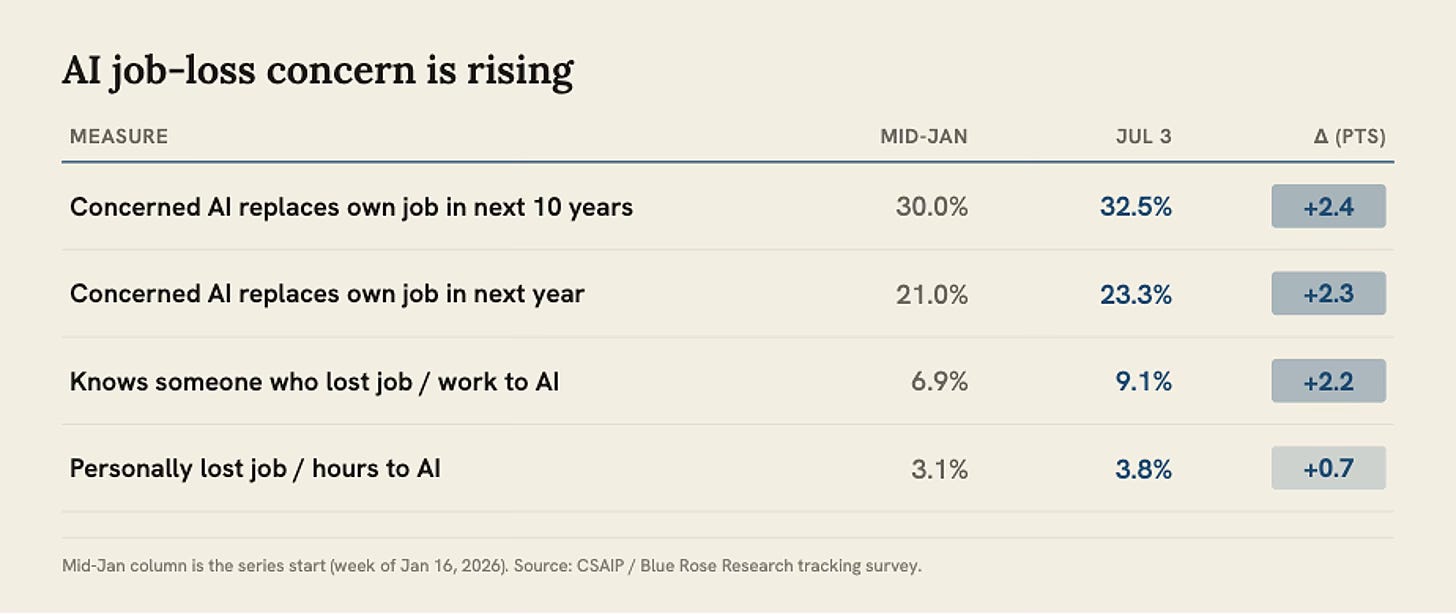
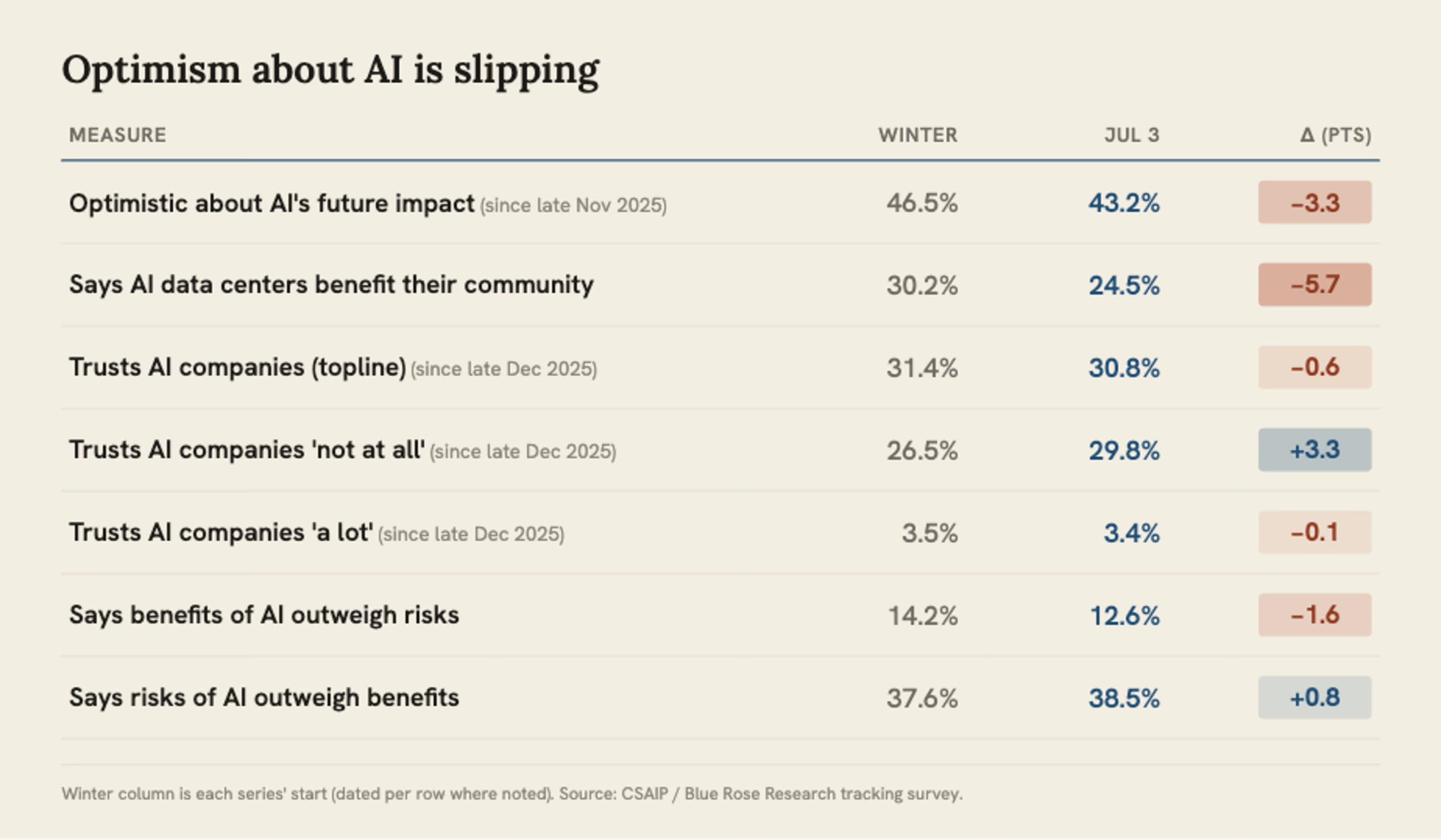
We also see shifts in public trust in AI. Optimism about AI’s future impact fell from 47 to 43 percent since late November. Belief that AI data centers benefit one’s community dropped from 30 to 25 percent. Topline trust in AI companies barely moved, but its composition changed. The share who trust these companies “not at all” rose from 27 to 30 percent as softer skeptics hardened, and only 3 percent now say they trust AI companies a lot. Just 13 percent say the benefits of AI outweigh the risks, against 39 percent who say the reverse.
Other polling shows that the public isn’t looking for doom narratives either. What the last six months show is a public whose direct experience and stated trust are both moving against the industry. The approaches that succeed will be those focused on concrete accountability over reassurance and abstract fear. Anyone proposing policy or trying to reset the story about AI and the economy will be working against that current rather than with it.
