

Lawmakers are slashing the safety net at the exact moment that the AI shock arrives. Families, who already face stagnant wages and declining economic security, are rightly worried about what AI may do to their economic future. But the policy on offer from Silicon Valley and Washington doesn’t match what voters actually want in this moment of upheaval.
The path to surviving the AI transition isn’t techno-utopian policy experiments like a Universal Basic Income proposed by Elon Musk and others. Instead, it is stopping immediate safety net cuts, taxing tech capital more than human labor, and ensuring the long-standing safety net programs Americans already trust can match the transitions our economy faces.
CSAIP’s national survey of 56,000 Americans shows that this approach is essential to allaying Americans’ fears about AI and building trust in government leaders to lessen the shock.
Washington is slashing the safety net just as the AI shock arrives
Americans need more economic security as automation threatens job security. But Washington is cutting the safety net right as the AI shock arrives. The extreme One Big Beautiful Bill Act has already forced about 5 million Americans off food assistance and 2.2 million off Medicaid, with the worst yet to come. New rules taking effect in January will push millions more off SNAP and Medicaid and put rural hospitals at risk. The law also left the Child Tax Credit’s refundable portion capped at $1,700, far short of the pandemic-era credit that drove child poverty to a record low of 5.2 percent in 2021. It has stayed above 13 percent ever since that credit lapsed.
The enhanced Affordable Care Act subsidies expired at the end of last year, after a shutdown fight failed to save them. Average premium payments jumped 58 percent and average deductibles rose 37 percent. CBO projects 3.7 million more people uninsured in 2027, and 3.8 million more a year on average through 2034. Now congressional Republicans are talking openly about cutting Medicare and Social Security.
Americans oppose these cuts. And they are happening as real wages are squeezed. They contribute to the feeling bipartisan majorities of voters already share that the economy is leaving families behind. A National Bureau of Economic Research study found a clear relation between cuts and Americans’ views about the economy. For every $1,000 in lost child tax credit benefits, consumer sentiment declined by about 1.7 points (2.4%).
CSAIP’s research finds Americans want to build on the very safety net under threat
CSAIP’s poll of 56,000 Americans finds they want an active government response to protect people from AI disruption. They are not interested in being paid not to work, which is what proposals like a universal basic income sometimes promise to do. They want to work, and support policies that transfer resources from corporations and the wealthiest Americans to support workers and families.
When asked about specific policies, they favor retraining and compensating workers who are impacted by AI automation – and they favor strengthening the existing social safety net.
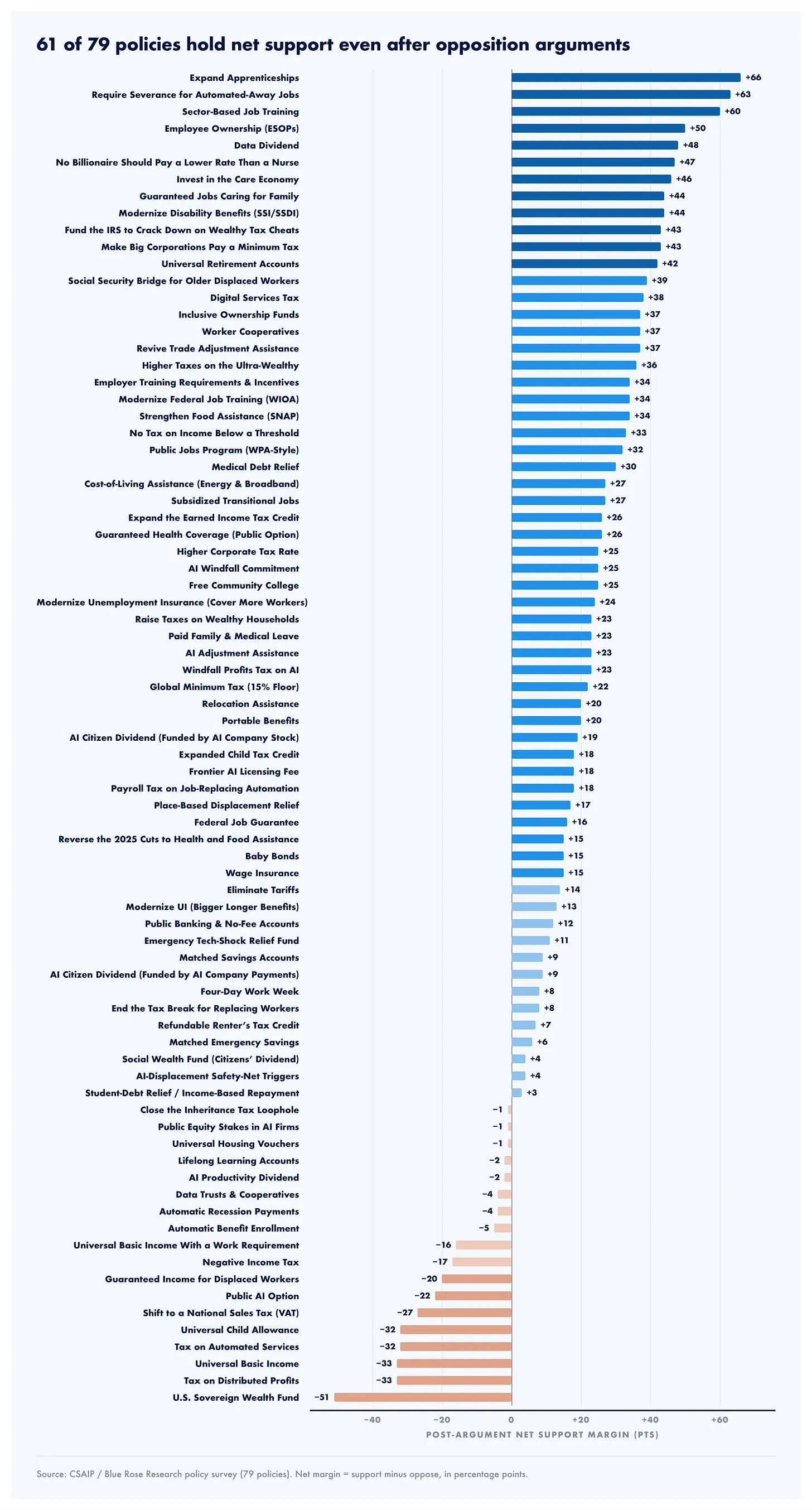
The survey shows that proposals to expand on existing programs score among the highest of any AI response we tested. “Using AI profits and tech-billionaire taxes to strengthen Social Security” scores in the 97th percentile. That same survey shows deep net support for expanding current programs, measured after voters hear arguments on both sides: “SS bridge for older workers” +39, “expand the EITC” +26, “expand CTC” +18.
Support for existing programs probably reflects familiarity. Plus, with trust in government low, many likely doubt Washington could design something new and get it right.
But big disruption demands big changes
Of course, the threat AI poses to workers and families is exposing deep cracks in our existing safety net in three big ways:
First, much of our existing safety net spending is funded primarily by a capped tax on labor. That no longer makes sense. Wages are growing more unequal, so more income sits above payroll tax caps and escapes capture, and labor’s share of US wealth has fallen to its lowest level ever recorded – a trend AI will accelerate without a policy response. Repeated cuts to taxes on capital gains but not on labor income has resulted in a perverse incentive to replace people with machines.
Much of our existing safety net spending is funded primarily by a capped tax on labor. That no longer makes sense.
Second, our current programs were designed for an earlier era when it was presumed a breadwinner worked for a single paternalistic employer for 40 years at a union wage while a homemaker was available to provide caregiving. That system was never truly inclusive, and it has grown less so as automation, globalization, and pressure on unionization reduced worker leverage. Workers are now more likely to be in insecure “gig” jobs without health or retirement benefits. And, as they work longer hours in an effort to attain economic security, they face new costs of caring for a child or parent. AI will exacerbate these trends if, as industry executives promise, it replaces or deskills additional jobs – including in professional services where workers have largely retained security from previous technology and trade shocks.
And third, our skimpy unemployment insurance was designed for a factory retooling. It leaves behind today’s gig workers, new entrants, low-paid workers, intermittent workers, those who needed to quit, or those who were fired for cause. Our current training programs are underfunded and, by the evidence, not ready for an AI transition which could upend entire sectors.
The current support system designed in the middle of the last century for a different economy is divided into a maze of programs administered in wildly divergent ways often with extra administrative burdens imposed on means-tested programs.
AI requires a redesign and expansion of these programs if Americans are to continue contributing to the new AI economy and share in the enormous wealth AI may produce.
Stop the cuts first. Then build on what people already trust.
That ambitious task cannot begin by making Americans less secure while promising to create an entirely new system that undermines the dignity of work. Intentional or not, this is what Washington is offering Americans today and it will only increase their cynicism about government and big tech.
Instead, the first thing political leaders should do is stop the cutting. Then, build on top of the scaffolding that Americans already trust.
The CSAIP survey shows support for this approach. Proposals to “modernize” current programs win net support: “modernize disability” +44, “modernize UI” +24. Specific proposals for how to expand existing programs also score high: “public option” for health care +26, “paid Family and Medical Leave” +23, “portable benefits” +20, “strengthen SNAP” +34.
The survey also shows support for new efforts to fill in major gaps that AI will exacerbate. They back a subsidized public jobs program along New Deal lines, by +32. Asked how government should respond to AI job losses, 62% choose creating public jobs vs. 17% for direct income support without work. And, despite elite skepticism that “pink collar” care jobs could ever be a popular part of the solution, “guaranteed jobs caring for family” scores +44 and “expand care economy” +46.
Americans want action now
Economically anxious Americans are demanding action from their political leaders. If those leaders instead stand by as they did during past disruptions from NAFTA and the China Shock to the internet and the Great Financial Crisis – or make things worse - populist anger against both them and AI is likely to increase.
