

Americans’ justifiable anxieties about wide-scale economic displacement are growing, but there is no consensus about the policies that are needed for an AI-powered economy. There is a growing gap between the rapid pace at which public opinion on AI is forming, and the lagging pace at which policy solutions are being developed.
CSAIP is working to close that gap. We sit at the intersection of public opinion research and policy design. Policy should respond to the concerns (and hopes!) Americans are expressing every day about how the economy should work in a potential era of major disruption. We partner with Blue Rose Research to continuously test how Americans are thinking about AI. And we help incubate responsive economic policies to ensure that the gains from AI flow to all Americans.
Importantly, while CSAIP publishes public opinion research, we do not simply endorse policies with the highest levels of support. Of course, the most popular policies may not be the best policies for responding to and redistributing the benefits of AI. Some policies that match the scale of the challenge face an uphill battle to earn support from the American public. Policymakers shouldn’t abandon these policies, but they should be honest about the political headwinds. We plan to bring together polling and rigorous policy analysis to identify solutions that are both popular and effective. That starts with knowing where people are today.
How do we measure public support for AI economic policies?
We’ve tested 79 policy ideas that could address the impact of AI on the economy. Our national survey of 56,000 respondents measured public support on 79 policies that range from AI-specific taxation to the creation of a U.S. sovereign wealth fund, from “data dividends” to wage insurance. Our survey results are available here. We went broad because all popularity is relative, so we need to understand where people are on a diverse battery of economic policies before we can say much about any specific intervention. We will update the rank order (relative popularity) of these policies over time and expand the economic policies we test as the field evolves.
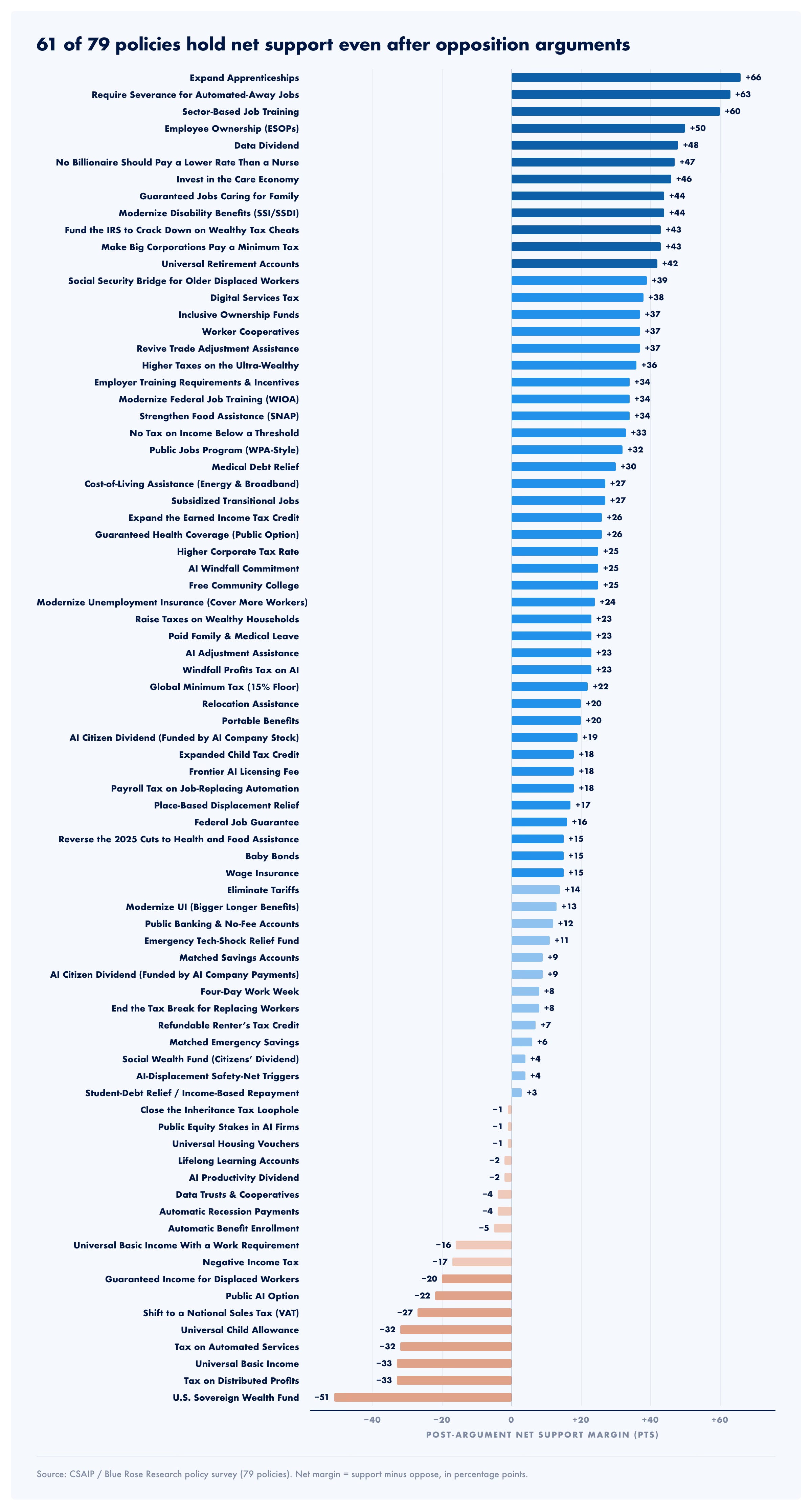
Our surveys include pro and con arguments. Blue Rose Research measures how support changes after respondents read very short arguments for and against the policy. Net support reported in this post, and elsewhere in CSAIP research, reflects net support after argumentation. After reading the arguments, respondents are asked to choose whether they support or oppose the policy without an undecided option. Net support expresses the difference between support and opposition in percentage points. This helps us understand how fixed opinions already are on any given policy idea, and how vulnerable a policy might be to basic opposition. More information about the polling methodology at Blue Rose Research can be found here.
We test AI policies against generic economic proposals. To understand what the public thinks about AI specific economic policies, we’ve also included other economic policies in this battery as useful sign posts for baseline support. These baseline policies do not include specific language related to AI disruption.
Americans support most progressive economic policies addressing AI disruption
Our polling indicates that Americans are broadly supportive of economic policies addressing AI disruption. Of the 79 economic policies we tested, 61 hold net approval even after strong opposition arguments. The dozen policy ideas that top the chart all maintain an approval margin of +40pp in the face of opposition arguments. And 48 policies maintain a net approval of +15pp or more.
In particular, we see significant support for policies that are straightforwardly redistributive (meaning they transfer resources from corporations and the wealthiest Americans to support workers and families), and that put AI companies on the hook (meaning they specifically ascribe responsibility to AI companies for disruption they may cause). When we look at policies that directly mention AI, 31 of 48 economic policies had majority support, and 19 of 27 of the policies specifically mentioning AI economic disruption had majority support.
Our bottom line finding is this: Americans want an active government response to protect people from AI disruption, and they are open to a big range of tools to do this. Americans strongly support job retraining and compensating workers who are impacted by AI automation, strengthening the existing social safety net, and funding training, apprenticeship, and care work through progressive taxation schemes.
For this initial polling instrument, CSAIP focused on four major policy areas:
Taxation and revenue
Income support and safety nets
Labor market and workforce development
Ownership, governance, and stakeholder models
Labor market and workforce development policies had significantly more support after argumentation than the other three categories tested. Taxation and revenue policies and ownership governments and stakeholder models also provide the least familiar mechanisms for addressing AI economic disruption.
What this polling doesn’t tell us
We’re clear-eyed about what this polling cannot tell us:
Will this policy match the scale of the disruption we may face? A popular policy is not the same as an effective policy. This polling helps us understand where the public is already open to a policy idea, and where bold policy ideas will need strong organizing to gain traction.
What message will break through? How will public opinion shift over time? A one-sentence, pro-con argumentation in our polling provides an initial read of how AI economic policies stack up against each other, rather than messaging guidance for any specific policy. Think of this polling instrument as a jumping-off point for future polling and message testing which will give us a better sense of what kinds of arguments make these policies more or less compelling to Americans.
What’s next?
Policy should be guided by listening to the American public. CSAIP is committed to sharing public polling that helps us build economic solutions that meet the scale of the challenges we face, and we’re committed to sparking new policy development that harnesses public opinion to meet this moment. Explore our policy polling here, and join us by submitting your ideas.
What is "Guaranteed Health Coverage (Public Option)" supposed to mean?
Those are two separate things that have nothing to do with each other.
I don't see in either of the methodology sections, did every single person answer all 79 questions twice (once with pros and cons, once without)? If not, were they just given a subsample, and how many people answered each question?
Was order randomized? Was the with/without pro- cons- tested within participant or just across participants?
If participants answered both before and after seeing the pros and cons, why are you only showing the "after" condition?